 Fiddleheads are the furled fronds of a young fern, harvested for use as a vegetable. Left on the plant, each fiddlehead would unroll into a new frond.
The fiddlehead resembles the curled ornamentation (called a scroll) on the end of a stringed instrument, such as a violin. It is also called a crozier, after the curved staff used by bishops, which has its origins in the shepherd's crook.
Fiddleheads have been part of traditional diets in much of Europe since the beginning of the Middle Ages, Asia as well as among Native Americans for centuries. by Tapas Together Edinburgh
Fiddleheads are the furled fronds of a young fern, harvested for use as a vegetable. Left on the plant, each fiddlehead would unroll into a new frond.
The fiddlehead resembles the curled ornamentation (called a scroll) on the end of a stringed instrument, such as a violin. It is also called a crozier, after the curved staff used by bishops, which has its origins in the shepherd's crook.
Fiddleheads have been part of traditional diets in much of Europe since the beginning of the Middle Ages, Asia as well as among Native Americans for centuries. by Tapas Together Edinburgh
Showing posts with label Creative Cuisine. Show all posts
Showing posts with label Creative Cuisine. Show all posts
Fiddlehead fern and bacon
Helecho cola de mono con panceta
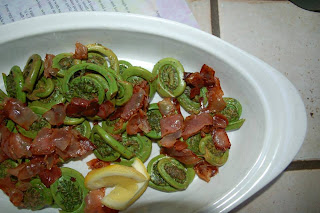 Fiddleheads are the furled fronds of a young fern, harvested for use as a vegetable. Left on the plant, each fiddlehead would unroll into a new frond.
The fiddlehead resembles the curled ornamentation (called a scroll) on the end of a stringed instrument, such as a violin. It is also called a crozier, after the curved staff used by bishops, which has its origins in the shepherd's crook.
Fiddleheads have been part of traditional diets in much of Europe since the beginning of the Middle Ages, Asia as well as among Native Americans for centuries. by Tapas Together Edinburgh
Fiddleheads are the furled fronds of a young fern, harvested for use as a vegetable. Left on the plant, each fiddlehead would unroll into a new frond.
The fiddlehead resembles the curled ornamentation (called a scroll) on the end of a stringed instrument, such as a violin. It is also called a crozier, after the curved staff used by bishops, which has its origins in the shepherd's crook.
Fiddleheads have been part of traditional diets in much of Europe since the beginning of the Middle Ages, Asia as well as among Native Americans for centuries. by Tapas Together Edinburgh
Fiddleheads are the furled fronds of a young fern, harvested for use as a vegetable. Left on the plant, each fiddlehead would unroll into a new frond.
The fiddlehead resembles the curled ornamentation (called a scroll) on the end of a stringed instrument, such as a violin. It is also called a crozier, after the curved staff used by bishops, which has its origins in the shepherd's crook.
Fiddleheads have been part of traditional diets in much of Europe since the beginning of the Middle Ages, Asia as well as among Native Americans for centuries. by Tapas Together Edinburgh

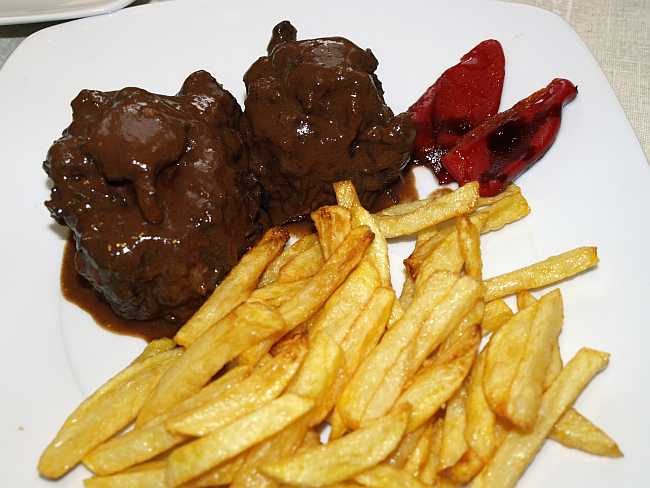
Dark chocolate oxtail
Rabo de toro al chocolate negro
 It is not unusual in Spanish cuisine to use chocolate to enrich and thicken savoury dishes. Here dark grated chocolate is teamed with cinnamon, ginger and other warming spices in this fabulous slow food recipe.
By Tapas Together Edinburgh
By Tapas Together Edinburgh
Vegetable tempura with aioli and brava sauce
Tempura de vegetales con alioli y salsa brava
 Tempura is a Japanese dish of seafood or vegetables.
The recipe for tempura was introduced to Japan by Iberian Jesuit missionaries particularly active in the city of Nagasaki also founded by the Portuguese, during the sixteenth century (1549).
Tempura is a Japanese dish of seafood or vegetables.
The recipe for tempura was introduced to Japan by Iberian Jesuit missionaries particularly active in the city of Nagasaki also founded by the Portuguese, during the sixteenth century (1549).
The word "tempura" comes from "ad tempora quadragesimae", a Latin expression used by both Spanish and Portuguese missionaries to refer to the Lenten period or Ember Days, Fridays, and other Christian holy days. Ember Days or quattuor tempora refer to holy days when Catholics avoid red meat and instead eat fish or vegetables.
There is still today a dish in Portugal very similar to tempura called peixinhos da horta, "garden fishies."
By Tapas Together Edinburgh
 Tempura is a Japanese dish of seafood or vegetables.
The recipe for tempura was introduced to Japan by Iberian Jesuit missionaries particularly active in the city of Nagasaki also founded by the Portuguese, during the sixteenth century (1549).
Tempura is a Japanese dish of seafood or vegetables.
The recipe for tempura was introduced to Japan by Iberian Jesuit missionaries particularly active in the city of Nagasaki also founded by the Portuguese, during the sixteenth century (1549).The word "tempura" comes from "ad tempora quadragesimae", a Latin expression used by both Spanish and Portuguese missionaries to refer to the Lenten period or Ember Days, Fridays, and other Christian holy days. Ember Days or quattuor tempora refer to holy days when Catholics avoid red meat and instead eat fish or vegetables.
There is still today a dish in Portugal very similar to tempura called peixinhos da horta, "garden fishies."
By Tapas Together Edinburgh
Carnation revolution salad
Ensalada homenaje Revolución de los claveles

This salad with tuna and Portuguese cheese (Queijo do Serra da Estela) is a tribute to the people who would lead to the fall of the fascism in Portugal. The main ingredient is the carnation flower which is the symbol of this revolution. After falling out of favor for many years, cooking and garnishing with flowers is back in vogue once again. Flower cookery has been traced back to Roman times, and to the Chinese, Middle Eastern, and Indian cultures. Edible flowers were especially popularin the Victorian era during Queen Victoria's reign. Today, many restaurant chefs and innovative home cooks garnish their entrees with flower blossoms for a touch of elegance. The secret to success when using edible flowers is to keep the dish simple, do not add to many other flavors that will over power the delicate taste of the flower. Today this nearly lost art is enjoying a revival.
By Tapas Together Edinburgh

This salad with tuna and Portuguese cheese (Queijo do Serra da Estela) is a tribute to the people who would lead to the fall of the fascism in Portugal. The main ingredient is the carnation flower which is the symbol of this revolution. After falling out of favor for many years, cooking and garnishing with flowers is back in vogue once again. Flower cookery has been traced back to Roman times, and to the Chinese, Middle Eastern, and Indian cultures. Edible flowers were especially popularin the Victorian era during Queen Victoria's reign. Today, many restaurant chefs and innovative home cooks garnish their entrees with flower blossoms for a touch of elegance. The secret to success when using edible flowers is to keep the dish simple, do not add to many other flavors that will over power the delicate taste of the flower. Today this nearly lost art is enjoying a revival.
By Tapas Together Edinburgh
Sardine crisp paper with prawn pâté
Papel crujiente de sardinas con paté de gambas

In gastronomy, some foods are described using words that might have the same meaning but they are not always interchangeable. Crisp and crunchy is a good example of it. Both have the phoneme "CR" due to they are onomatopoeias. The crisp characteristic is seen by a sensorial analysis, the ear is the first to perceive if a food is crispy. In this case, the Sardine paper make a noise when it's broken. The crunchy is perceived directly on teeth and in this case, the food has a density and considerable water content. Example of crunchy foods are apples, celery and fresh carrots.
By Tapas Together Edinburgh

In gastronomy, some foods are described using words that might have the same meaning but they are not always interchangeable. Crisp and crunchy is a good example of it. Both have the phoneme "CR" due to they are onomatopoeias. The crisp characteristic is seen by a sensorial analysis, the ear is the first to perceive if a food is crispy. In this case, the Sardine paper make a noise when it's broken. The crunchy is perceived directly on teeth and in this case, the food has a density and considerable water content. Example of crunchy foods are apples, celery and fresh carrots.
By Tapas Together Edinburgh
Cod Spanish doughnut
Churro de bacalao
 Deep-fried pastry and hot chocolate are still a breakfast cult in Madrid. They have helped many night owls to face the cold gray light of day. In many families, they form part of the Sunday ritual.
But innovation has added new ingredients to the recipe turning into a savory bite.
The cod churro shouldn't be dipped into chocolate, but into mayonnaise, Biscay sauce or alioli
Deep-fried pastry and hot chocolate are still a breakfast cult in Madrid. They have helped many night owls to face the cold gray light of day. In many families, they form part of the Sunday ritual.
But innovation has added new ingredients to the recipe turning into a savory bite.
The cod churro shouldn't be dipped into chocolate, but into mayonnaise, Biscay sauce or alioli
By Tapas Together Edinburgh

By Tapas Together Edinburgh
Chard stalks cordon bleu style
San Jacobo de pencas de acelga
 This is a fond of travelling recipe, not because its origin was in Byzantium, and then the Arab brought into Spain, but it took the name from the Way of St James, the most important Christian pilgrimage. (Camino de Santiago...Yakub apostle, Jacob, Jacobo o Yago Sankt Yago -> Santiago).
This dish is based on Galician cachopo but replacing the meat with chard with has a slightly bitter taste and is used in Arab cuisine.
This is a fond of travelling recipe, not because its origin was in Byzantium, and then the Arab brought into Spain, but it took the name from the Way of St James, the most important Christian pilgrimage. (Camino de Santiago...Yakub apostle, Jacob, Jacobo o Yago Sankt Yago -> Santiago).
This dish is based on Galician cachopo but replacing the meat with chard with has a slightly bitter taste and is used in Arab cuisine.
By Tapas Together Edinburgh

By Tapas Together Edinburgh
Tripe with hummus
Callos con hummus
 Tripe is usually a side dish of a chick peas. This recipe is an update version of the old Castile stew with the influence of the Arab flavours carried by North Africans who are moving to Spain.
Many cuisine-related sources describe hummus as an ancient food, and it is possible that hummus was eaten when the moors used to rule Spain.
The earliest known recipes for a dish similar to hummus bi tahini are recorded in cookbooks published in Cairo in the 13th century.
Tripe is usually a side dish of a chick peas. This recipe is an update version of the old Castile stew with the influence of the Arab flavours carried by North Africans who are moving to Spain.
Many cuisine-related sources describe hummus as an ancient food, and it is possible that hummus was eaten when the moors used to rule Spain.
The earliest known recipes for a dish similar to hummus bi tahini are recorded in cookbooks published in Cairo in the 13th century.
By Tapas Together Edinburgh

By Tapas Together Edinburgh
Savory fruit macedonia
Ensalada de macedonia salada
 Fruit macedonia is a fresh fruit salad and is a common dessert in Spain.
The word macedonia was popularised at the end of the 18th century to refer to mixed fruit salad, alluding to the diverse origin of the people of Alexander's Macedonian Empire. It is sometimes said that it refers to the ethnic mixture in Ottoman 19th century Macedonia, but the chronology and contemporary sources do not support this interpretation. Macedoine can refer to any medley of unrelated things, not necessarily edible.
Fruit macedonia is a fresh fruit salad and is a common dessert in Spain.
The word macedonia was popularised at the end of the 18th century to refer to mixed fruit salad, alluding to the diverse origin of the people of Alexander's Macedonian Empire. It is sometimes said that it refers to the ethnic mixture in Ottoman 19th century Macedonia, but the chronology and contemporary sources do not support this interpretation. Macedoine can refer to any medley of unrelated things, not necessarily edible.
By Tapas Together Edinburgh

By Tapas Together Edinburgh
Coke and wine chicken
Pollo al kalimotxo
 As tasty as bizarre. Kalimotxo is a drink consisting of equal parts red wine and cola-based soft drink, developed by a group of friends during the 1972 Puerto Viejo festivities in the Greater Bilbao. They noticed that the wine they had bought was not in good condition, so they decided to mix it with something to kill the sour taste.
But chicken has been cooked in wine around the southern Europe for centuries and coca-cola wings is a widely consumed and very popular dish in Hong Kong and in other parts of China. It’s nearly like the Asian equivalent to the popular American buffalo wings. It is commonly served as appetizers at bars and restaurants, well known for its sweet taste and crunchy bite.
As tasty as bizarre. Kalimotxo is a drink consisting of equal parts red wine and cola-based soft drink, developed by a group of friends during the 1972 Puerto Viejo festivities in the Greater Bilbao. They noticed that the wine they had bought was not in good condition, so they decided to mix it with something to kill the sour taste.
But chicken has been cooked in wine around the southern Europe for centuries and coca-cola wings is a widely consumed and very popular dish in Hong Kong and in other parts of China. It’s nearly like the Asian equivalent to the popular American buffalo wings. It is commonly served as appetizers at bars and restaurants, well known for its sweet taste and crunchy bite.
By Tapas Together Edinburgh

By Tapas Together Edinburgh
Liquid croquettes
Croquetas liquidas
 The liquid croquette was created in 2006 by Ferran Adriá, considered one of the best chefs in the world and it's a perfect combo of liquid and crunch.
Adriá has referred to his cooking as deconstructivist.He defines the term as 'Taking a dish that is well known and transforming all its ingredients, or part of them; then modifying the dish's texture, form and/or its temperature. Deconstructed, such a dish will preserve its essence... but its appearance will be radically different from the original's.' His stated goal is to "provide unexpected contrasts of flavour, temperature and texture. Nothing is what it seems.
The liquid croquette was created in 2006 by Ferran Adriá, considered one of the best chefs in the world and it's a perfect combo of liquid and crunch.
Adriá has referred to his cooking as deconstructivist.He defines the term as 'Taking a dish that is well known and transforming all its ingredients, or part of them; then modifying the dish's texture, form and/or its temperature. Deconstructed, such a dish will preserve its essence... but its appearance will be radically different from the original's.' His stated goal is to "provide unexpected contrasts of flavour, temperature and texture. Nothing is what it seems.
By Tapas Together Edinburgh

By Tapas Together Edinburgh
Mediterranean-style chicories
Endivias a la mediterranea
 Wild chicory leaves are usually bitter. Their bitterness was appreciated in certain Mediterranean cuisines, reaching back to ancient Egyptian time.
But the torpedo shaped chicory was "rediscover" by accident in Belgium in 1830. The head gardener of the Botanical Gardens in Brussels forgot about the roots left covered in soil in the cellar. He discovered that chicory produced lovely, pale, tight cone shaped heads. It took another few decades before the growing method was perfected but once introduced to the general public, it became as firmly established in Belgian cuisine as 'frites and mussels' or Belgian chocolates.
Nowadays Chicory is cooked back to the Mediterraean area.
Wild chicory leaves are usually bitter. Their bitterness was appreciated in certain Mediterranean cuisines, reaching back to ancient Egyptian time.
But the torpedo shaped chicory was "rediscover" by accident in Belgium in 1830. The head gardener of the Botanical Gardens in Brussels forgot about the roots left covered in soil in the cellar. He discovered that chicory produced lovely, pale, tight cone shaped heads. It took another few decades before the growing method was perfected but once introduced to the general public, it became as firmly established in Belgian cuisine as 'frites and mussels' or Belgian chocolates.
Nowadays Chicory is cooked back to the Mediterraean area.
By Tapas Together Edinburgh

By Tapas Together Edinburgh
Duck confit with Castilian lentils
Confit de pato con lentejas castellanas
 Although Spaniards insist that our gastronomic culture is independent and try to disregard the French influence in the cuisine, there has always been a lively exchange of cultural and gastronomic traditions in the Pyrenean region.
The Landes region, France's most important center for rearing and processing ducks, lies directly over the Spanish border. and the wave of gourmet cookery in 1970s caused many culinary influences to spill over into Spain.
Although Spaniards insist that our gastronomic culture is independent and try to disregard the French influence in the cuisine, there has always been a lively exchange of cultural and gastronomic traditions in the Pyrenean region.
The Landes region, France's most important center for rearing and processing ducks, lies directly over the Spanish border. and the wave of gourmet cookery in 1970s caused many culinary influences to spill over into Spain.
By Tapas Together Edinburgh

By Tapas Together Edinburgh
Ceviche with Basque pickle hot peppers
Cebiche con piparras
 Ceviche is a return dish. This Peruvian dish is made from fresh raw fish marinated in lime juice and spiced with "ají" or chili peppers. It's becoming popular in Spain thanks to the Latin-Americans who are moving to improve their life quality.
The predecessor to the dish was brought to Peru by Moorish women from Granada who accompanied the Spanish conquistadors and colonizers, and this dish eventually evolved into what now is considered ceviche. In addition the term has its origin in the Spanish-Arabic word escabeche which means pickle.
Ceviche is a return dish. This Peruvian dish is made from fresh raw fish marinated in lime juice and spiced with "ají" or chili peppers. It's becoming popular in Spain thanks to the Latin-Americans who are moving to improve their life quality.
The predecessor to the dish was brought to Peru by Moorish women from Granada who accompanied the Spanish conquistadors and colonizers, and this dish eventually evolved into what now is considered ceviche. In addition the term has its origin in the Spanish-Arabic word escabeche which means pickle.
By Tapas Together Edinburgh

By Tapas Together Edinburgh
Pasta nest with prickly pear and chicken
Nidos de pasta con higo chumbo y pollo
 The Spanish conquistadors brought the prickly pear back with them from the New World as an ornamental plant. Its tasty fruit can be bought fresh or dried at any market in Canary Islands.
However, much more profitable is to use the plant as a host for the cochineal beetle, from which the highly sought carmine red food coloring is obtained.
Cochineal production soon became the islands' main source of income, due to the enormous demand for the coloring in the textile industry. But in 1880 the market collapsed with the development of artificial aniline coloring.
The Spanish conquistadors brought the prickly pear back with them from the New World as an ornamental plant. Its tasty fruit can be bought fresh or dried at any market in Canary Islands.
However, much more profitable is to use the plant as a host for the cochineal beetle, from which the highly sought carmine red food coloring is obtained.
Cochineal production soon became the islands' main source of income, due to the enormous demand for the coloring in the textile industry. But in 1880 the market collapsed with the development of artificial aniline coloring.
By Tapas Together Edinburgh

By Tapas Together Edinburgh
Smoked sardines with mango
Sardinas ahumadas con mango
 Mangoes have been cultivated in South Asia for thousands of years. By the 10th century AD, cultivation had begun in East Africa. Cultivation came later to Brazil, the West Indies and Mexico, where an appropriate climate allows its growth.
Mangoes are also grown in Andalusia (mainly in Málaga province), as its coastal subtropical climate is one of the few places in mainland Europe that allows the growth of tropical plants and fruit trees. The Canary Islands are another notable Spanish producer of the fruit.
Mangoes have been cultivated in South Asia for thousands of years. By the 10th century AD, cultivation had begun in East Africa. Cultivation came later to Brazil, the West Indies and Mexico, where an appropriate climate allows its growth.
Mangoes are also grown in Andalusia (mainly in Málaga province), as its coastal subtropical climate is one of the few places in mainland Europe that allows the growth of tropical plants and fruit trees. The Canary Islands are another notable Spanish producer of the fruit.
By Tapas Together Edinburgh

By Tapas Together Edinburgh
Carrot and seaweed soup
Crema de zanahorias y algas
 Along the Spanish history some poor harvest caused a devastating famine. But it occured to nobody even in the worst moments that eating seaweed could be a solution.
Spain has 3.168 km of shore plenty of seaweed but it wasn't used as an ingredient until the influence of the japanese cuisine at the 90s.
Seaweed has been a part of diets in China, Japan, and Korea since prehistoric times and nowadays Spain is a reference in the Algaculture. A big variety of seaweeds are added to traditional dishes
Along the Spanish history some poor harvest caused a devastating famine. But it occured to nobody even in the worst moments that eating seaweed could be a solution.
Spain has 3.168 km of shore plenty of seaweed but it wasn't used as an ingredient until the influence of the japanese cuisine at the 90s.
Seaweed has been a part of diets in China, Japan, and Korea since prehistoric times and nowadays Spain is a reference in the Algaculture. A big variety of seaweeds are added to traditional dishes
By Tapas Together Edinburgh

By Tapas Together Edinburgh
Stuffed courgette mushrooms with romesco sauce
Setas de calabacines rellenos con salsa romesco
 Romesco hails from Tarragona, and is considered a staple in Catalan cuisine. As with many staples deeply rooted in a culture, there is often no single way to prepare it. A basic principle exists – the use of key ingredients such as almonds,
garlic, olive oil, bread and dried chiles. From there, variations abound depending on the cook or kitchen, including the addition of roasted tomatoes and red peppers, red wine and herbs. No matter the spin, romesco is versatile. It is a fair partner to grilled fish and meats, but it's really in its niche alongside vegetables.
Romesco hails from Tarragona, and is considered a staple in Catalan cuisine. As with many staples deeply rooted in a culture, there is often no single way to prepare it. A basic principle exists – the use of key ingredients such as almonds,
garlic, olive oil, bread and dried chiles. From there, variations abound depending on the cook or kitchen, including the addition of roasted tomatoes and red peppers, red wine and herbs. No matter the spin, romesco is versatile. It is a fair partner to grilled fish and meats, but it's really in its niche alongside vegetables.
By Tapas Together Edinburgh

By Tapas Together Edinburgh
Fettuccini made of courgette with spinach sauce
Espaguetis de calabacines con salsa de espinacas
 Since the time of Cato, basic pasta dough has been made mostly of wheat flour. The consumption of pasta has changed over time; it was once a small, simple item, but it is now often eaten in much larger portions and as part of complex, sophi
sticated dishes.
Courgette, like all squash, has its ancestry in the Americas. However, the varieties of squash typically called "zucchini" were developed in Italy, many generations after their introduction from the "New World".
Since the time of Cato, basic pasta dough has been made mostly of wheat flour. The consumption of pasta has changed over time; it was once a small, simple item, but it is now often eaten in much larger portions and as part of complex, sophi
sticated dishes.
Courgette, like all squash, has its ancestry in the Americas. However, the varieties of squash typically called "zucchini" were developed in Italy, many generations after their introduction from the "New World".
By Tapas Together Edinburgh

By Tapas Together Edinburgh
Couscous made of cauliflower
Cuscús hecho con coliflor
 Couscous is a staple food which the first written references is from a 13th-century Andalusian cookbook, "The cookbook of the Maghreb and Al-Andalus". Couscous was known to the Nasrid royalty in Granada and it was eaten in subsequent centur
ies by the Moriscos.
Alcuzcuz, as it was know before in old spanish, is mentioned in Don Quixote as well.
If the cauliflower is grated, a kind of semolina foodstuff will be obtained similar to the classic berber dish.
Couscous is a staple food which the first written references is from a 13th-century Andalusian cookbook, "The cookbook of the Maghreb and Al-Andalus". Couscous was known to the Nasrid royalty in Granada and it was eaten in subsequent centur
ies by the Moriscos.
Alcuzcuz, as it was know before in old spanish, is mentioned in Don Quixote as well.
If the cauliflower is grated, a kind of semolina foodstuff will be obtained similar to the classic berber dish.
By Tapas Together Edinburgh

By Tapas Together Edinburgh
Subscribe to:
Posts (Atom)