 Another two products that are abundant in Spain are fruits and wine. So what is better than to pair the two of them? Fall is a great season to combine them with the picking of ripe apples and the grape harvest. Some years the abundance of grapes and wine in "La Rioja" was so great that with the surplus they celebrated a festival called "la batalla del vino" (the wine battle). On this day groups of young (and not so young) people squirted wine on each other with sprayers. This celebration continues and is held June 29th in Haro. By Tapas Together Edinburgh
Showing posts with label Sweet Bites. Show all posts
Showing posts with label Sweet Bites. Show all posts
Baked apple in red wine
Manzanas asadas en vino tinto
 Another two products that are abundant in Spain are fruits and wine. So what is better than to pair the two of them? Fall is a great season to combine them with the picking of ripe apples and the grape harvest. Some years the abundance of grapes and wine in "La Rioja" was so great that with the surplus they celebrated a festival called "la batalla del vino" (the wine battle). On this day groups of young (and not so young) people squirted wine on each other with sprayers. This celebration continues and is held June 29th in Haro. By Tapas Together Edinburgh
Another two products that are abundant in Spain are fruits and wine. So what is better than to pair the two of them? Fall is a great season to combine them with the picking of ripe apples and the grape harvest. Some years the abundance of grapes and wine in "La Rioja" was so great that with the surplus they celebrated a festival called "la batalla del vino" (the wine battle). On this day groups of young (and not so young) people squirted wine on each other with sprayers. This celebration continues and is held June 29th in Haro. By Tapas Together Edinburgh

Corn porridge
Morokil
 Many Basque people went to the Americas on expeditions during the 16th century. In the Americas the Basque discovered corn.
The Basque Country is mountainous, wet, and humid, with a lot of rain. For those reasons, there was not an area to grow wheat. Bringing corn and adapting it to the Basque Country was easy. They started harvesting corn to feed the animals and to grind in mills as flour.
Many Basque people went to the Americas on expeditions during the 16th century. In the Americas the Basque discovered corn.
The Basque Country is mountainous, wet, and humid, with a lot of rain. For those reasons, there was not an area to grow wheat. Bringing corn and adapting it to the Basque Country was easy. They started harvesting corn to feed the animals and to grind in mills as flour.
By Tapas Together Edinburgh

By Tapas Together Edinburgh
Home-made banana ice cream
Helado casero de plátano

Portuguese seafarers brought the banana to Canary Islands from West African Guinea. At first it was planted as an exotic ornamental shrub, and taken by the Spanish conquerors to Mexico and Caribbean. However, it was not until the second half of the 19th century that is was exploited economically by English businessmen in Gran Canaria and Tenerife, when planted a dwarf banana in 1878. The export business was soon flourishing and the banana has been the most important crop and the main commercial product of the archipelago for over hundred years.
By Tapas Together Edinburgh

Portuguese seafarers brought the banana to Canary Islands from West African Guinea. At first it was planted as an exotic ornamental shrub, and taken by the Spanish conquerors to Mexico and Caribbean. However, it was not until the second half of the 19th century that is was exploited economically by English businessmen in Gran Canaria and Tenerife, when planted a dwarf banana in 1878. The export business was soon flourishing and the banana has been the most important crop and the main commercial product of the archipelago for over hundred years.
By Tapas Together Edinburgh
Orange juice marinated strawberries
Fresas marinadas en zumo de naranja
 In Europe, there were three main strawberry species. By the time American plants were introduced,
The Mapuche and Huilliche Indians of what today it is called Chile cultivated the female strawberry species until 1551 when the Spanish came to conquer the land. In 1765, a European explorer recorded the cultivation of the Chilean strawberry. At first introduction to Europe, the plants grew vigorously but produced no fruit. It was discovered in 1766 that the female plants could only be pollinated by plants that produced large fruit. This is when the Europeans became aware that plants had the ability to produce male-only or female-only flowers.
In Europe, there were three main strawberry species. By the time American plants were introduced,
The Mapuche and Huilliche Indians of what today it is called Chile cultivated the female strawberry species until 1551 when the Spanish came to conquer the land. In 1765, a European explorer recorded the cultivation of the Chilean strawberry. At first introduction to Europe, the plants grew vigorously but produced no fruit. It was discovered in 1766 that the female plants could only be pollinated by plants that produced large fruit. This is when the Europeans became aware that plants had the ability to produce male-only or female-only flowers.
By Tapas Together Edinburgh
 In Europe, there were three main strawberry species. By the time American plants were introduced,
The Mapuche and Huilliche Indians of what today it is called Chile cultivated the female strawberry species until 1551 when the Spanish came to conquer the land. In 1765, a European explorer recorded the cultivation of the Chilean strawberry. At first introduction to Europe, the plants grew vigorously but produced no fruit. It was discovered in 1766 that the female plants could only be pollinated by plants that produced large fruit. This is when the Europeans became aware that plants had the ability to produce male-only or female-only flowers.
In Europe, there were three main strawberry species. By the time American plants were introduced,
The Mapuche and Huilliche Indians of what today it is called Chile cultivated the female strawberry species until 1551 when the Spanish came to conquer the land. In 1765, a European explorer recorded the cultivation of the Chilean strawberry. At first introduction to Europe, the plants grew vigorously but produced no fruit. It was discovered in 1766 that the female plants could only be pollinated by plants that produced large fruit. This is when the Europeans became aware that plants had the ability to produce male-only or female-only flowers.By Tapas Together Edinburgh
Almond and egg yolk tart
Técula mécula

Many of the recipes relied heavily on egg yolks, which the nuns received free from the winemakers who needed only the whites to clarify their sherries and red wines. Técula mécula is not a magic phrase as "abracadabra" but a dessert traditional to Olivenza (Extremadura region). It may have a Portuguese origin as Olivenza was under Portuguese sovereignty between 1297 (Treaty of Alcañices) and 1801 when it was ceded to Spain after the "War of the Oranges" . There are still traces of Portuguese culture and language in the people.
By Tapas Together Edinburgh

Many of the recipes relied heavily on egg yolks, which the nuns received free from the winemakers who needed only the whites to clarify their sherries and red wines. Técula mécula is not a magic phrase as "abracadabra" but a dessert traditional to Olivenza (Extremadura region). It may have a Portuguese origin as Olivenza was under Portuguese sovereignty between 1297 (Treaty of Alcañices) and 1801 when it was ceded to Spain after the "War of the Oranges" . There are still traces of Portuguese culture and language in the people.
By Tapas Together Edinburgh
Northern Spanish Crêpes with apple compote
Filloas o frixuelos con compota de manzana
 Today it's Pancake Day. The name predated the Reformation and referred to the common Christian tradition of eating special rich foods before the fasting season of Lent.
Frixuelos or filloas are a simple crepe-like dessert made of flour, milk, eggs and oil.
Frixuelos is the mane in Asturias and Leon. At the same time they are know as filloas in Galicia.
They are a concoction traditionally eaten for carnival. Kids dress up in their carnival outfits, then bug the neighbours for hot-off-the-grill filloas, dipped in sugar.
Today it's Pancake Day. The name predated the Reformation and referred to the common Christian tradition of eating special rich foods before the fasting season of Lent.
Frixuelos or filloas are a simple crepe-like dessert made of flour, milk, eggs and oil.
Frixuelos is the mane in Asturias and Leon. At the same time they are know as filloas in Galicia.
They are a concoction traditionally eaten for carnival. Kids dress up in their carnival outfits, then bug the neighbours for hot-off-the-grill filloas, dipped in sugar.
By Tapas Together Edinburgh

By Tapas Together Edinburgh
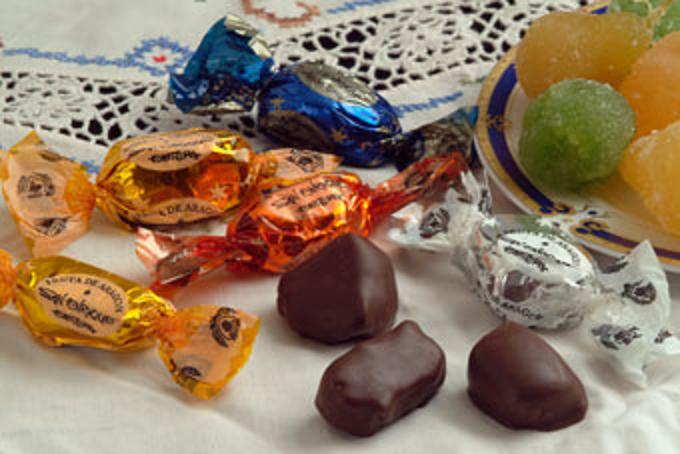
Candied fruit from Aragon
Frutas de Aragón
 Already in 1603, it was common practice in Calatayud to make a gift of bread, wine and candied fruit to friends from out of the town. Even in those times, the rivers of the area were famous for the superb quality of the fruit that grew on their banks. Also the inhabitants practiced the traditional method of fruit preservation by syrup.
Around 70 years ago, some enterprising Aragonese confectioners hit on the idea of covering them with chocolate, becoming Frutas de Aragón.
Already in 1603, it was common practice in Calatayud to make a gift of bread, wine and candied fruit to friends from out of the town. Even in those times, the rivers of the area were famous for the superb quality of the fruit that grew on their banks. Also the inhabitants practiced the traditional method of fruit preservation by syrup.
Around 70 years ago, some enterprising Aragonese confectioners hit on the idea of covering them with chocolate, becoming Frutas de Aragón.
By Tapas Together Edinburgh
By Tapas Together Edinburgh
Marzipan
Mazapán
 There are proposed two lines for its origin; they are not necessarily contradictory and may be complementary.
The recipe moved on from Persia to the Middle East and then to Europe through Al-Andalus.
Another possible geographic origin is in Spain, then known as Al-Andalus. In Toledo (850-900, though more probably 1150 during the reign of Alfonso VII) this specialty was known as Postre Regio instead of Mazapán) and there are also mentions in The Book of One Thousand and One Nights of an almond paste eaten during Ramadan and as an aphrodisiac. Mazapán is Toledo's most famous dessert, often created for Christmas, and has PGI status.
There are proposed two lines for its origin; they are not necessarily contradictory and may be complementary.
The recipe moved on from Persia to the Middle East and then to Europe through Al-Andalus.
Another possible geographic origin is in Spain, then known as Al-Andalus. In Toledo (850-900, though more probably 1150 during the reign of Alfonso VII) this specialty was known as Postre Regio instead of Mazapán) and there are also mentions in The Book of One Thousand and One Nights of an almond paste eaten during Ramadan and as an aphrodisiac. Mazapán is Toledo's most famous dessert, often created for Christmas, and has PGI status.
By Tapas Together Edinburgh

By Tapas Together Edinburgh
Christmas shortbread
Polvorón
 A polvorón (From polvo, the Spanish word for dust) is a type of heavy, soft and very crumbly Spanish shortbread made of flour, sugar, milk, and nuts.
Polvorones are popular in all Spain and ex-Spanish colonies in Latin America, as well as the Philippines, during the Christmas period.
There are authors who claim a possible Levantine origin, based on a similar sweet known as ghurayba, but that theory is spoiled if we bear in mind that one of the traditional main ingredients in the polvorones is pig fat, taboo ingredient for Muslims.
A polvorón (From polvo, the Spanish word for dust) is a type of heavy, soft and very crumbly Spanish shortbread made of flour, sugar, milk, and nuts.
Polvorones are popular in all Spain and ex-Spanish colonies in Latin America, as well as the Philippines, during the Christmas period.
There are authors who claim a possible Levantine origin, based on a similar sweet known as ghurayba, but that theory is spoiled if we bear in mind that one of the traditional main ingredients in the polvorones is pig fat, taboo ingredient for Muslims.
By Tapas Together Edinburgh

By Tapas Together Edinburgh
Spiced chocolate
Chocolate especiado
 The earliest record of using chocolate dates back before the Olmec. By the 15th century, the Aztecs gained control of a large part of Mesoamerica, and adopted cacao into their culture.
The first European contact with chocolate came when Montezuma introduced Hernán Cortés, a Spanish conquistador, to xocolatl in the 16th century.
The first recorded shipment of chocolate to Europe for commercial purposes was in a shipment from Veracruz to Sevilla in 1585. It was still served as a beverage, but the Spaniards added cane sugar to counteract the natural bitterness and removed the chili pepper, in addition they added cinnamon as well as other spices
The earliest record of using chocolate dates back before the Olmec. By the 15th century, the Aztecs gained control of a large part of Mesoamerica, and adopted cacao into their culture.
The first European contact with chocolate came when Montezuma introduced Hernán Cortés, a Spanish conquistador, to xocolatl in the 16th century.
The first recorded shipment of chocolate to Europe for commercial purposes was in a shipment from Veracruz to Sevilla in 1585. It was still served as a beverage, but the Spaniards added cane sugar to counteract the natural bitterness and removed the chili pepper, in addition they added cinnamon as well as other spices
By Tapas Together Edinburgh

By Tapas Together Edinburgh
Fig mousse
Mousse de higo
 The fig was always a controversial plant. To Christians it was explicitly called the Christian fig, whereas the prickly fruit of the opuntia cactus was called the Moors fig. The Arab saw it similarly- only the other way round.
The tree has been connected with sin since Biblical times. After all, Eve and Adam, once they became embarrassed by their nakedness, covered themselves up with fig leaves.
The fig was always a controversial plant. To Christians it was explicitly called the Christian fig, whereas the prickly fruit of the opuntia cactus was called the Moors fig. The Arab saw it similarly- only the other way round.
The tree has been connected with sin since Biblical times. After all, Eve and Adam, once they became embarrassed by their nakedness, covered themselves up with fig leaves.
By Tapas Together Edinburgh

By Tapas Together Edinburgh
Sponge cake
Bizcocho
 The World known "sponge cake" is originated from the Iberian Peninsula. It was in its origin a Sephardi dessert made for Jewish Passover.
In 1492, a royal edict brought to an end the era marked by Jewish presence on Spanish soil. An era that had lasted for a thousand years. After the expulsion, the Sephardi Jews were spread along the Mediterranean Sea taking with them, their culinary traditions.
That is the reason why sponge cake named after the same fashion, which literally means "Bread of Spain" , in French: Pain d'Espagne, in Italian: Pan di Spagna, in Portuguese: Pão de Espanha, in Bulgarian: пандишпан, in Greek: Pantespani, in Turkish: Pandispanya and in Bosnian as patišpanja
The World known "sponge cake" is originated from the Iberian Peninsula. It was in its origin a Sephardi dessert made for Jewish Passover.
In 1492, a royal edict brought to an end the era marked by Jewish presence on Spanish soil. An era that had lasted for a thousand years. After the expulsion, the Sephardi Jews were spread along the Mediterranean Sea taking with them, their culinary traditions.
That is the reason why sponge cake named after the same fashion, which literally means "Bread of Spain" , in French: Pain d'Espagne, in Italian: Pan di Spagna, in Portuguese: Pão de Espanha, in Bulgarian: пандишпан, in Greek: Pantespani, in Turkish: Pandispanya and in Bosnian as patišpanja
By Tapas Together Edinburgh

By Tapas Together Edinburgh
Lemon and firewater sorbet
Sorbete de limón y aguardiente
 Aguardiente is a Spanish high alcoholic beverage which means "burning water". Galicia, the northwestern region of Spain, is renowned for its quality and variety of aguardientes. Probably the most famous type is "Augardente de bagazo" (Aguardiente de Orujo), which is obtained from the distillation of the pomace of grapes, and is clear and colourless. It typically contains over 50% alcohol, sometimes significantly more, and is still made traditionally in many villages across Galicia today.
By Tapas Together Edinburgh

By Tapas Together Edinburgh
Quince paste with cheese
Dulce de membrillo con queso
 Traditionally and predominantly from Spain, Portugal and Italy (exported when the South of Italy was part of the Kingdom of Aragón), dulce de membrillo is a firm, sticky, sweet reddish hard paste made of quince.
Quince paste has its origins in antiquity and ancient recipes indicate that it was formerly made with honey. Greek legend recounts how the nymphs offered it to Zeus when he was a child.
Traditionally and predominantly from Spain, Portugal and Italy (exported when the South of Italy was part of the Kingdom of Aragón), dulce de membrillo is a firm, sticky, sweet reddish hard paste made of quince.
Quince paste has its origins in antiquity and ancient recipes indicate that it was formerly made with honey. Greek legend recounts how the nymphs offered it to Zeus when he was a child.
By Tapas Together Edinburgh

By Tapas Together Edinburgh
Saint Teresa's egg yolks
Yemas de Santa Teresa
 The dedication shown by Castilians in their comsumption of sugary sweet confections sometimes resembles that of religious cult.
Saint Teresa was born in Avila in 1515, an inspired blend of mytical power with down-to-earth common sense. She said "God can be also found among the cooking pots".
Egg yolks have very little at all to do with the Saint. They were brought to Avila in the 17th century by a owner of a confectionery business in Madrid. His sons gave the house's trademark confection its most illustrious name.
The dedication shown by Castilians in their comsumption of sugary sweet confections sometimes resembles that of religious cult.
Saint Teresa was born in Avila in 1515, an inspired blend of mytical power with down-to-earth common sense. She said "God can be also found among the cooking pots".
Egg yolks have very little at all to do with the Saint. They were brought to Avila in the 17th century by a owner of a confectionery business in Madrid. His sons gave the house's trademark confection its most illustrious name.
By Tapas Together Edinburgh

By Tapas Together Edinburgh
Cheesecake with Seville orange marmalade
Tarta de queso con mermelada de naranja amarga
 The arabs cultivated the bitter orange as an ornamental tree. And as Islam spread, it reached Spain, where it became famous as the Seville orange.
Once a year, oranges of this variety are collected from trees in Seville and shipped to Britain to be used in marmalade. However, the fruit is rarely consumed locally in Andalusia.
Seville oranges are only available for roughly a period of six weeks from early to mid January and they are used mainly for making marmalade because they have a high pectin content and also because they are very sour and bitter as a fruit.
The arabs cultivated the bitter orange as an ornamental tree. And as Islam spread, it reached Spain, where it became famous as the Seville orange.
Once a year, oranges of this variety are collected from trees in Seville and shipped to Britain to be used in marmalade. However, the fruit is rarely consumed locally in Andalusia.
Seville oranges are only available for roughly a period of six weeks from early to mid January and they are used mainly for making marmalade because they have a high pectin content and also because they are very sour and bitter as a fruit.
By Tapas Together Edinburgh

By Tapas Together Edinburgh
Strawberries with Juanola sauce
Fresas con salsa de juanolas
 Juanolas are palate-cleansing pastilles made of unsweetened liquorice sold in the pharmacies of Spain. This palate-cleansing effect leads to the intensification of the flavour of the strawberries and makes for a surprisingly pleasant combination.
By Tapas Together Edinburgh

By Tapas Together Edinburgh
Cider and apple cake
Tarta de manzana y sidra
 What I like about Asturias above all is the people's enormous affection for their locally produced cider. The consumption of cider in Asturias is of 54 litres per person/year, probably the highest in any European region.
There could be no better celebration of that than this sponge cake, layered apples tossed with cinnamon , then baked and drizzled with a glacé-style icing made from sugar and reduced vintage cider.
What I like about Asturias above all is the people's enormous affection for their locally produced cider. The consumption of cider in Asturias is of 54 litres per person/year, probably the highest in any European region.
There could be no better celebration of that than this sponge cake, layered apples tossed with cinnamon , then baked and drizzled with a glacé-style icing made from sugar and reduced vintage cider.
By Tapas Together Edinburgh

By Tapas Together Edinburgh
Rice pudding
Arroz con leche
 While there is a great variety of sweet things in Spanish cooking, few are meant as puddings to have after a meal. We are more to have with a cup of "café con leche".
On the whole ,after a meal Spaniards prefer fresh fruit, nuts, yogurt or
ice cream, but rice pudding is the dessert eaten with any regularity, in the home and in restaurants.
Instead of baking the rice and milk as it's done in Britain, we are simmered together on the top of the stove, flavoured with lemon and cinnamon.
While there is a great variety of sweet things in Spanish cooking, few are meant as puddings to have after a meal. We are more to have with a cup of "café con leche".
On the whole ,after a meal Spaniards prefer fresh fruit, nuts, yogurt or
ice cream, but rice pudding is the dessert eaten with any regularity, in the home and in restaurants.
Instead of baking the rice and milk as it's done in Britain, we are simmered together on the top of the stove, flavoured with lemon and cinnamon.
By Tapas Together Edinburgh

By Tapas Together Edinburgh
Sun-dried tomato with chocolate candy
Bombón de tomate seco y chocolate
 Althoght it sounds like a savory chocolate, this is in fact quite sweet. Tomatoes are fruits and become sweet, especially when sun dried.
Sun-dried tomatoes are ripe tomatoes that are placed in the sun to remove most of the water content from the tomatoes. After the procedure, the tomato fruits will keep their nutritional value.
Althoght it sounds like a savory chocolate, this is in fact quite sweet. Tomatoes are fruits and become sweet, especially when sun dried.
Sun-dried tomatoes are ripe tomatoes that are placed in the sun to remove most of the water content from the tomatoes. After the procedure, the tomato fruits will keep their nutritional value.
By Tapas Together Edinburgh

By Tapas Together Edinburgh
Subscribe to:
Posts (Atom)